Home > Baseball Arm Injury Guide > Spondylolysis in Baseball Players
BASEBALL INJURY GUIDE / SPONDYLOLYSIS
Spondylolysis in Baseball Players: How to Treat Low Back Pain in Denver Athletes
Written by Dr. Edwin Porras, DPT, OCS, Board Certified Orthopedic Specialist, published researcher on baseball throwing programs, former Minnesota Twins medical staff. Co-authored by Thaddeus Hayes, MAT, LAT, ATC, former Minnesota Twins athletic trainer.
If your back hurts when you swing a bat, throw, or run as a teenage athlete (especially baseball, gymnastics or soccer), you may need to see a medical professional to be sure you don't have a stress fracture in your low back. A stress fracture there is called "lumbar spondylolysis" or LS. The fracture is located in a small bone bridge in the low back. This is extremely common in athletes who have low back pain (Li et al., 2023).
Most athletes with LS are treated with sports physical therapy like at PRO Athlete PT in Centennial, CO. and do well - especially when caught early. In a 2024 study of 85 adolescent baseball players, only seven had surgery (Teruya et al., Asian Spine Journal, 2024). The catch, though, is you'll likely need to take a long break from painful activities.
Here's what to know:
- 41.7% of athletes who have low back pain end up with LS. In plain words, that is about 4 out of 10 athletes with a sore low back.
- In a 2024 study of baseball players with low back pain, they were sent for an MRI. More than half of them had early stage LS in the spine (Kato et al., Journal of Orthopaedic Science, 2024).
- That does not mean more than half of baseball players have LS. It means that among baseball players whose backs already hurt enough to get checked, it was common. If your back hurts, that is you.
What spondylolysis actually is
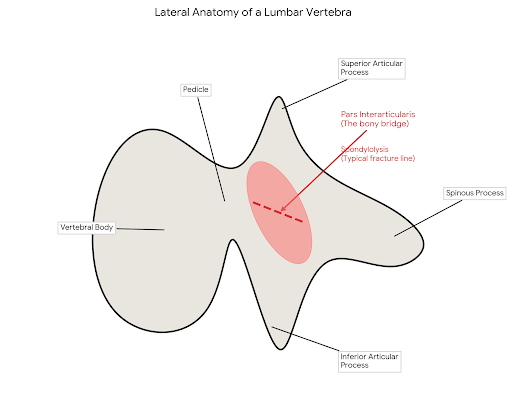
Think of your vertebrae like a stack of blocks. On the back of each block is a thin bridge of bone called the pars interarticularis.
Spondylolysis is a crack in that bridge. No single movement breaks it. It is an overuse fracture, the same way a paper clip snaps after you bend it back and forth enough times.
You will also hear it called a pars defect or a pars fracture. Same thing.
If the crack goes all the way through and the bone starts to slide forward, that is a different word: spondylolisthesis. Catching the problem early is how you keep it from getting there.
Why baseball does this to a back
Pitching and hitting requires your spine to violently rotate. Think of wringing a towel then folding the top half of it backwards.
A three dimensional model of the lumbar spine found that stress on the pars runs highest under extension and rotation (think about a backswing), and that those two loads are the high risk ones for spondylolysis (Chosa et al., Journal of Orthopaedic Research, 2004). Motion capture work on 187 pitchers found the low back actually hyperextends (over extends beyond "normal" range of motion) through the first two thirds of the pitch cycle, in youth, adolescent, and college arms alike (Singh et al., Journal of Applied Biomechanics, 2018).
Put those together. Arch plus rotate, hundreds of times a week, on a growing spine. That is the recipe.
How common is LS in athletes?
In Japan, it shows up in roughly 30 percent of professional baseball and soccer players, about five times the rate in the general population (Sakai et al., Journal of Orthopaedic Science, 2010). Across throwing sports generally, a study of more than 3,000 Spanish elite athletes put it at 26.67 percent vs. just 3 to 7 percent in the general population (Soler and Calderon, American Journal of Sports Medicine, 2000).
Right handed pitcher? Check the left side first.
This is the part that surprises people.
The crack tends to show up on the side opposite your throwing arm. In one study of young athletes, the dominant hand for pitching or batting lined up with lesions on the other side (Yokoe et al., Journal of Orthopaedic Surgery and Research, 2020). A 2024 review of 85 adolescent players found the same pattern. Among the pitchers, 16 lesions were on the throwing side and 32 were on the other side (Teruya et al., Asian Spine Journal, 2024).
Two things to know before you take that to the bank. Both studies only looked at players who already showed up at a hospital, so they do not describe every baseball player. And the same 2024 paper found no link at all between which side hurts and which side you bat from.
There is a second reason to catch it early. Once one side cracks, the other side starts taking more load. A biomechanical study of athletes with a one sided defect found stress on the opposite side increased as much as 12.6 times (Sairyo et al., American Journal of Sports Medicine, 2005). One crack can become two.
Pitchers vs. Hitters: Who Cracks Their Back More?
Pitchers and hitters both twist hard. So which one is more likely to get LS? The honest answer is that we don't know yet. No study has shown that pitchers get them more often than hitters.
What we do know is where the crack shows up. A 2024 study looked at 85 young baseball players who already had LS (Teruya et al., 2024). Here is what it found:
- Pitchers: The crack was twice as likely to be on the side opposite the throwing arm. A right-handed pitcher was more likely to crack the left side.
- Fielders: Neither side was more common.
- Hitters: The side a player batted from made no difference.
Why would pitching do this? When a pitcher throws, his back arches and twists hard toward his throwing arm. That squeezes the bone on the other side. Pitching also twists the body faster than swinging a bat does.
Should I get an MRI if my low back hurts?
The 2024 Fukushima study compared players who had an early stage stress fracture against players whose back pain came from something else. After adjusting for age and position, four things separated them (Kato et al., Journal of Orthopaedic Science, 2024).
*Ask your doctor if they think you need imaging*
- Pain that has lasted four weeks or more. About three times the odds of LS.
- Pain that bothers him while running. Close to three times the odds.
- Pain that started on one side. Close to three times the odds. One side, not across the whole back.
- One tender spot on a single bump of the spine. About three times the odds.
-
Pain when he arches backward showed up in 85 percent of the players who had a stress fracture too.
None of those four proves anything on its own. Stack two or three of them and you have a player who should be getting imaging, not another week of stretching.
Why a normal X-ray does not clear him
Early LS is hard to see on a plain X-ray. The bone has not fully cracked yet. What is happening is swelling inside the bone, and that does not show up well on film.
MRI picks it up earlier, and it does it without a dose of radiation (Kato et al., 2024).
So a normal X-ray does not mean his back is fine. It means the X-ray did not find it.
Why catching it early decides everything
LS gets staged by how far along the crack is. Early stages can heal. Late stages usually do not.
That single fact is the whole ballgame. Early on, care is built around unloading the spine. That can mean time off from your sport so you can rehab. Once it reaches the final stage, healing the bone is off the table and the work shifts to controlling pain and rebuilding strength around it (Teruya et al., Asian Spine Journal, 2024).
In that same group of 85 players, 44 lesions were already at the final stage by the time they were seen.
Catching it before it gets to that stage is the goal.
Rest alone is not a plan.
We say it constantly around here. Rest is not Rehab. A bone stress injury in the spine is the closest thing to an exception, because you genuinely do have to take load off the crack for it to heal.
But here is where athletes lose seasons. An athlete gets told to rest. He rests. Six weeks later the pain is quieter, so he goes back to playing the same way, with the same workload and no build up - and he's right back to where he started.
Time off protects the bone. What he does during and after that time off is what decides whether this happens again.
Can you prevent it?
None of the studies here tested prevention, so nobody should sell you a guaranteed fix. However, making your back and hips as strong as possible and working smarter and harder by managing your workloads goes a long way. You can read more about athlete's routines and recovery here.
How we handle it at PRO
PRO Athlete Physical Therapy is a sports physical therapy in Denver. Dr. Edwin Porras spent time on the Minnesota Twins medical staff, and Thaddeus Hayes spent five years as an athletic trainer keeping pros on the field. Back when we worked in pro ball, nobody ever answered a month of one sided back pain with "rest and see".
Here is how we work it.
We screen him first. That means checking what the research says to check. How long the pain has run, whether it started on one side, whether running bothers it, and whether one spot on his spine is tender.
If those line up, he needs imaging and we send for it. We will tell you that straight and help you get there fast instead of running him through six visits first.
If it is spondylolysis, we send him to an orthopedic doctor to make sure this is a case that can be rehabbed.
If this is a rehab-able case, we always start by improving strength of the low back and flexibility of the hips slowly. Then we build you up to total body strength before writing your return to sport program. Notice we didn't mention "core strength". Core strength is important but there are actually no good studies that show core strength, by itself, protects athletes from low back pain.
We work out of Lakewood and Centennial, and we see players from across the Front Range, including Aurora, Highlands Ranch, Boulder, and the rest of the Denver metro.
Common questions from parents and players
What is a pars defect?
It is another name for spondylolysis. The pars is the small bridge of bone on the back of a vertebra, and a defect means a crack in it. Pars fracture means the same thing.
Is spondylolysis career ending?
While there is no way to account for every individual, a study with a mix of adults and kids show anywhere from 61% to 90% of athletes can return from this injury and about 8 in 10 return to play at the same level as before.
How long does it take to heal?
A large study could not find a consistent time frame and settled on 3 to 6 months - which is consistent with what we've seen at PRO Athlete PT in Denver.
Is spondylolysis the same as a herniated disc?
No. A disc problem involves the cushion between vertebrae. Spondylolysis is a crack in the bone itself. Age matters here. One comparison found spondylolysis in 47 percent of young athletes with low back pain, while 48 percent of adult low back pain traced back to a disc (Micheli and Wood, 1995). Treating a teenage thrower's back like an adult's back is how this gets missed.
Can my son keep playing through it?
No. Once diagnosed with a stress fracture with the use of CT and MRI, bone healing can take anywhere from 12 to 16 weeks but restoring strength, mobility and your return to sport plan to get you back safely could take longer. Continuing to play through this can cause more serious issues down the road. Playing through undiagnosed low back pain is how an early crack becomes a permanent one. Get the diagnosis and the stage first otherwise this can become a long-term problem.
Will he need surgery?
Most cases are managed without surgery. In the group of 85 adolescent players described above, seven had surgery and the rest were treated conservatively with rest, bracing, and rehab (Teruya et al., 2024).
Why does only one side hurt in my baseball player?
Because pitching loads one side. The arch and rotate pattern concentrates stress on the pars, and in pitchers the lesions show up more often on the side opposite the throwing arm (Teruya et al., 2024). A right handed pitcher usually feels it on the left.
Does it show up on an X-ray?
Not always, especially early. MRI is better for finding it before the bone fully cracks.
What should he do, and what should he avoid?
PRO Athlete PT in Denver recommends avoiding painful activities which usually involves twsting and extending the back. However this is not an injury you should try and rehab on your own. Find a good sports physical therapist (potentially outside of your insurance) to make sure this injury does not get worse.
If your back has hurt for more than a month, get it looked at
You do not need to know whether it is a stress fracture before you call. That is our job. What you do need is to stop waiting on it. Four weeks of one sided back pain in a thrower is one of the four signals the research ties to early stage stress fractures, and the window where the bone can still heal does not stay open forever.
Keep reading
-
Baseball arm injury guide, the full library of what goes wrong in a throwing athlete
-
Little League elbow, the same overuse pattern in a different joint
Visit us
PRO Athlete Physical Therapy, Lakewood
5825 West 6th Avenue, Unit 3A
Lakewood, CO 80214
Phone: (720) 248-7515
PRO Athlete Physical Therapy, Centennial
7240 South Fraser Street
Centennial, CO 80112
Phone: (720) 248-7527
Serving Lakewood, Centennial, Denver, Aurora, Highlands Ranch, Boulder, and the Front Range.
References
- Kato K, Otoshi K, Kobayashi K, et al. Clinical characteristics of early-stage lumbar spondylolysis detected by magnetic resonance imaging in male adolescent baseball players. Journal of Orthopaedic Science. 2024;29(1):35-41. doi:10.1016/j.jos.2022.10.014
- Teruya S, Funayama T, Tatsumura M, et al. Characteristics of lumbar spondylolysis in adolescent baseball players: relationship between the laterality of lumbar spondylolysis and the throwing or batting side. Asian Spine Journal. 2024;18(2):260-264. doi:10.31616/asj.2023.0360
- Yokoe T, Tajima T, Sugimura H, et al. Comparison of symptomatic spondylolysis in young soccer and baseball players. Journal of Orthopaedic Surgery and Research. 2020;15(1):378. doi:10.1186/s13018-020-01910-4
- Chosa E, Totoribe K, Tajima N. A biomechanical study of lumbar spondylolysis based on a three-dimensional finite element method. Journal of Orthopaedic Research. 2004;22(1):158-163. doi:10.1016/S0736-0266(03)00160-8
- Sairyo K, Katoh S, Sasa T, et al. Athletes with unilateral spondylolysis are at risk of stress fracture at the contralateral pedicle and pars interarticularis. American Journal of Sports Medicine. 2005;33(4):583-590. doi:10.1177/0363546504269035
- Singh H, Lee M, Solomito MJ, Merrill C, Nissen C. Lumbar hyperextension in baseball pitching: a potential cause of spondylolysis. Journal of Applied Biomechanics. 2018;34(6):429-434. doi:10.1123/jab.2017-0230
- Sakai T, Sairyo K, Suzue N, Kosaka H, Yasui N. Incidence and etiology of lumbar spondylolysis: review of the literature. Journal of Orthopaedic Science. 2010;15(3):281-288. doi:10.1007/s00776-010-1454-4
- Soler T, Calderon C. The prevalence of spondylolysis in the Spanish elite athlete. American Journal of Sports Medicine. 2000;28(1):57-62. doi:10.1177/03635465000280012101
- Micheli LJ, Wood R. Back pain in young athletes: significant differences from adults in causes and patterns. Archives of Pediatrics and Adolescent Medicine. 1995;149(1):15-18. doi:10.1001/archpedi.1995.02170130017004
- Matsuura T, Takata Y, Iwame T, et al. Limiting the pitch count in youth baseball pitchers decreases elbow pain. Orthopaedic Journal of Sports Medicine. 2021;9(3):2325967121989108. doi:10.1177/2325967121989108
Written by Edwin Porras, DPT, OCS, Board Certified Orthopedic Specialist, former Minnesota Twins medical staff, published researcher, featured in The Athletic and The New York Times. Co-authored by Thaddeus Hayes, MAT, LAT, ATC, former Minnesota Twins athletic trainer and Arm Care Director at PRO Athlete Physical Therapy.
This article is for education and is not medical advice. Spondylolysis is diagnosed with imaging ordered by a physician. If your athlete is dealing with low back pain, get evaluated by a licensed provider.